
21 Science-Backed Ways to Regulate Your Nervous System
An evidence-based list of what actually works (with meta-analyses to prove it)

This article is related to the following previous posts, but can also be read in isolation:
· An Introduction To Your Nervous System
· What A Regulated Nervous System Feels Like
· How To Read A Scientific Paper
· I Studied Brain Changes In Older Women With Alzheimer’s Risk. Here’s What We Found
· Decoding and Soothing Your Body’s Stress Signals
· Why Incomplete Advice to “Notice Your Body” Causes More Stress
· How to Respond to Your Nervous System
Your nervous system is constantly working to keep you balanced. It is shifting between states of activation and rest, stress and recovery, green and yellow. When this system gets stuck in overdrive, everything suffers: your sleep, your mood, your digestion, your relationships. The good news is there are countless evidence-based ways to support nervous system regulation, and many of them are simple, accessible, and free.
Below is a numbered list of interventions that have been scientifically shown to calm the nervous system, improve vagal tone, reduce stress hormones, or enhance parasympathetic activity. Each item includes a link to a recent meta-analysis or systematic review in case you would like to read more about it in detail. A few of these, I have personal experience with (some in a professional research context).
It is important to me to not spread trendy wellness advice, but show science-backed techniques and findings of what actually works. In future posts, I will get into more detail of some of these items, so stay tuned!
Understanding the Evidence
Meta-Analysis
A meta-analysis systematically searches the literature to find all research publications that address a specific question. After carefully selecting eligible studies, researchers perform statistical analyses that combine data across all the independent studies. They also evaluate study quality and potential biases.
The results provide a powerful overview of whether a specific treatment or intervention actually works. Meta-analyses can distinguish which specific outcomes are reliably affected by an intervention. For example, there might be 48 eligible studies examining treatment X on heart rate, heart rate variability (HRV), salivary cortisol, blood pressure, and subjective stress. Not every study measures all outcomes, and results often vary between studies. A meta-analysis organizes these findings and reveals which measures consistently change with the intervention.
Read a meta-analysis when you want to know: What are the most consistent, reliable findings for a specific intervention?
Systematic review
A systematic review is a comprehensive, methodical examination of all available research on a specific question, using explicit criteria to evaluate and summarize the evidence. Unlike a meta-analysis, it may not include statistical pooling of data.
Systematic reviews typically provide more detailed discussion of different types of interventions, variations in how they’re implemented, outcome measures used, and nuanced findings across studies. The trade-off is less statistical power compared to meta-analyses.
Read a systematic review when you want to know: What does the full landscape of research look like, including details about how studies were conducted and what specific findings emerged?
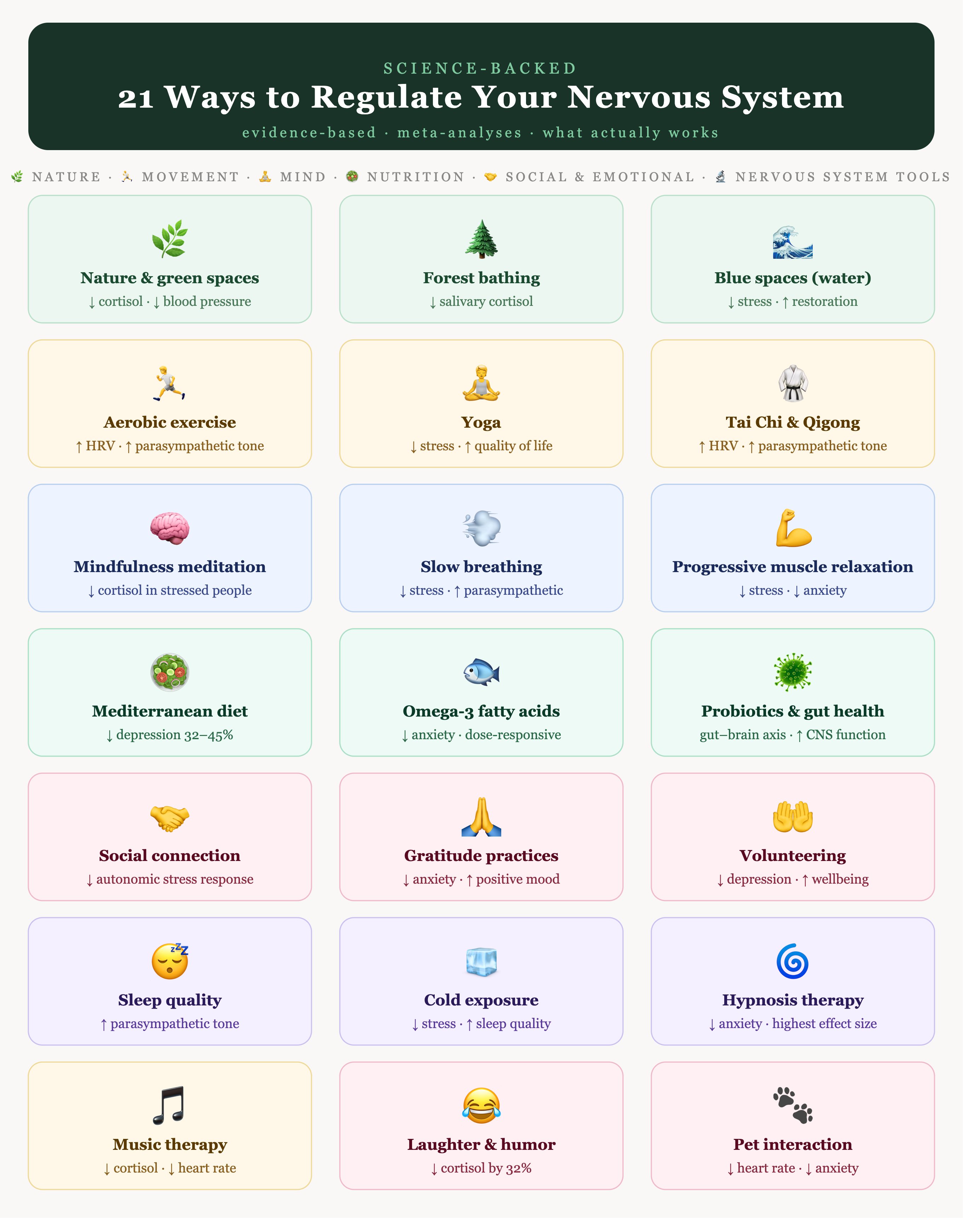
The List
1. Nature exposure & green spaces: A 2021 meta-analysis showed that exposure to natural environments was associated with decreased salivary cortisol (stress hormone), lower blood pressure (stress increases blood pressure, so this is good), and reduced sympathetic (fight-flight) nervous system measures. These are all markers of sympathetic reduction. Overall, research participants reported increases in restorative measures.
2. Aerobic exercise: A 2025 meta-analysis confirmed that long-term aerobic training significantly reduces the part of heart rate variability (HRV) that reflects inhibition of sympathetic activity and enhancement of parasympathetic tone (same as under Point 1). This was particularly the case after more than 8 weeks of training.
3. Mindfulness meditation: A meta-analysis published in 2020 found that meditation interventions reduce cortisol (stress hormones measured in blood and saliva) levels in stressed people, although less so in people who were not stressed.
4. Yoga: A 2024 meta-analysis found short-term positive effects of yoga on stress and quality of life, however, the scientific evidence is overall not of high quality. This means that while there is some preliminary evidence, more high-quality studies are needed.
5. Omega-3 fatty acids: A 2024 dose-response meta-analysis found that each 1 gram (~0.4 oz) a day of omega-3 supplementation produced a moderate decrease in anxiety symptoms, with greatest improvements in anxiety at 2 gram (0.71 oz) a day. Again, higher quality studies are needed, but this is a good first step.
6. Social support & connection: A 2021 synthesis of 23 meta-analyses covering over 1.4 billion participants (this is a lot of evidence!) confirmed that social support buffers the stress response through downregulation of the autonomic nervous system and the brain-stress (hypothalamic-pituitary-adrenal) axis.
7. Sleep quality: A 2025 meta-analysis found that sleep deprivation significantly increases markers of sympathetic tone (fight-flight response) and reduces parasympathetic tone (vagal: rest-and-digest), indicating sympathetic predominance and vagal suppression - the reverse of good nervous system regulation. This means that a lack of sleep has negative effects on the nervous system and prioritizing sleep quality may be one of the most foundational things you can do for your nervous system.
8. Slow breathing: A 2023 meta-analysis found breathwork was associated with significantly lower levels of stress, anxiety, and depression, presumably due to increased parasympathetic activity.
9. Music therapy: A 2020 systematic review and meta-analysis found music therapy speaking to the participants’ memories and emotions is strongly associated with stress reduction through decreased cortisol levels, lowered heart rate, and decreases in mean arterial pressure.
10. Tai Chi & Qigong: A 2025 systematic review and meta-analysis found that Tai Chi and Qigong produced moderate improvements in two key heart rate variability markers of parasympathetic (rest-and-digest) activity. Benefits were greatest in people who already had a healthy baseline stress response - suggesting these practices may be especially well-suited as a preventive or maintenance tool, rather than only for those already in dysregulation.
11. Laughter and humor: A 2023 systematic review and meta-analysis found that spontaneous laughter (watching a comedy video or attending laughter therapy sessions) reduced cortisol (stress hormone) by nearly 32%. Even a single laughter session produced significant reductions.
12. Mediterranean diet: A 2025 systematic review found that the Mediterranean diet reduces depressive symptoms by 32–45%, working through anti-inflammatory properties, omega-3 fatty acids, and promotion of gut microbiome diversity.
13. Cold exposure: A 2025 systematic review and meta-analysis evaluated cold-water immersion and found improvements in stress, sleep quality, and quality of life, and overall subjective health ratings.
14. Hypnosis therapy: A 2019 meta-analysis found that hypnosis reduced anxiety more than approximately 79% of control participants at end of treatment, with even stronger longer-term effect. This makes hypnosis therapy one of the highest effect-size interventions on this list.
15. Probiotics & gut health: A 2022 meta-analysis found that probiotics predominantly exerted effects on central nervous system (brain and spinal cord) function, with the gut microbiota influencing the nervous system through the microbiota-gut-brain axis.
16. Forest bathing (Shinrin-yoku): A 2019 meta-analysis found that in most studies, salivary cortisol levels were significantly lower after forest bathing.
17. Progressive muscle relaxation (PMR): A 2024 systematic review found that PMR is effective in reducing stress, anxiety, and depression, with efficacy enhanced when combined with other interventions.
18. Pet interaction: A 2018 meta-analysis shows positive effects of pet therapy on heart rate, anxiety, and stress.
19. Gratitude practices: A 2023 meta-analysis found that gratitude interventions significantly reduced symptoms of anxiety and depression and improved feelings of gratitude, positive mood, mental health, and emotions.
20. Blue spaces (water): A systematic review and meta-analysis found that blue spaces contribute to stress reduction, cognitive restoration, relaxation, and improved mental wellbeing, through mechanisms similar to those proposed for green space.
21. Volunteering: A 2024 umbrella review of systematic reviews found that volunteering is associated with reduced mortality, improved mental health (including lower depression and anxiety), and greater quality of life and social connection. Benefits were especially pronounced for older adults and those with lower baseline life satisfaction - suggesting volunteering may be particularly valuable for those who need it most.
Conclusion
It is unrealistic to go from crisis to peace, but the more time you spend engaging in mind-body-nourishing activities, the closer your mind and body get to recovery. Years ago, I started volunteering in equine-assisted therapy programs and while it did nothing to fix my burn-out-like symptoms overall, it made the problems look quite a bit smaller in relation and that improved my quality of life tremendously. This way, these regulation techniques can potentially help you in 2 different ways:
1. They provide a healthy distraction from your life’s stressors
2. They have a positive influence by actively reducing stress
This list does not mean you should be doing all of these things. Even incorporating one or two into your daily or weekly routine can make a meaningful difference in how your nervous system responds to stress. The selection is up to your own preference. Whatever on this list resonates with you and fits your life is a great place to start. If you want to establish a new routine or habit, integrate one item at a time into your life. Doing too many things tends not to lead to lasting positive change. The key is consistency in doing things that calm your nervous system and finding what works for your body, your schedule, and your life.
If this resonates with you, I write regularly about the nervous system, stress, and the science behind how we heal. You can follow along here on Substack – I’d love to have you.
Topics I cover include: understanding your nervous system, reading and applying scientific research, stress physiology, and evidence-based approaches to well-being.
Your nervous system is adaptable. It can learn, heal, and recalibrate. These are no quick fixes (there is no quick fix for an overwhelmed nervous system), but they are powerful tools for long-term resilience and well-being.
Regulation isn’t a destination. It’s a practice - and every small, consistent act of care is a signal to your nervous system that it is safe to rest.
Which activities have you tried?
Thank you for sharing! :-)
I love that this is rooted in research rather than trends. As someone who works with movement, breathwork, and nutrition, one thing I've noticed is that people often go looking for the "best" nervous system tool, when consistency matters far more than perfection. A daily walk outside, quality sleep, meaningful connection, and a few minutes of slow breathing can be profoundly powerful when practiced over time. Thank you for bringing the science into a conversation that so often gets lost in wellness hype!