

How to Read Supplement Research Like a Scientist
Understanding Clinical Trials, Systematic Reviews, Meta-Analyses, and What “Statistically Significant” Really Means

Last week, I broke down the science behind 8 popular calming supplements (“Calm in a Capsule – What Science Really Says About 10 Popular Calming Supplements”). Many of you asked: “How do I actually evaluate these studies myself?” and “What does it mean when research says something ‘works’?”
Most supplement headlines are technically true. And that can be a problem.
This week, we will explore what to make of scientific results and how read between the lines of what scientists are telling (unfortunately, most science is written for other experts, not lay people).
You will learn to spot the difference between a result that’s merely “statistically significant” and one that actually makes a meaningful difference in your life.
Whether you’re considering a new supplement, reading health news, or you just want to become a savvier consumer of science, this guide will give you the tools to know what type of information to look for, not just for supplements, but also for medications.
Do you want to learn more about becoming a smarter consumer of health science?
Subscribe to get my evidence-based breakdowns delivered to your inbox. I read the research papers so you don’t have to - but I will always teach you how to read them yourself.
The Problem with Social Media “Health Experts”
Scroll through Instagram, TikTok, or YouTube for five minutes and you’ll find dozens of people confidently telling you which supplements to take, which studies prove they work, and why your doctor is behind the times. Some of these creators are well-intentioned. A few even have credentials, like master’s degrees and others. But here’s what most of them have in common: they don’t know how to evaluate the quality of the studies they’re citing.
This isn’t a minor gap. In research, not all studies are created equal. A single small trial with 30 participants, no placebo group, and industry funding is technically a “study” - and it can generate a headline just as easily as a rigorous meta-analysis of 2,000 people. When a wellness influencer says “studies show this supplement reduces anxiety,” they are rarely telling you that the one study they found had a high risk of bias, lasted only two weeks, and was funded by the company that makes the supplement.
The result is a strange information environment where technically true statements lead to genuinely misleading conclusions. “Studies show supplement X works” can mean anything from overwhelming, replicated evidence across thousands of participants to a single poorly designed trial that happened to find a positive result and got published anyway.
This is not about distrusting science. It’s about reading it properly - something that takes training most people, including many science communicators online, simply haven’t had.
Randomized Clinical Trial (RCT)
A randomized clinical trial (RCT) is considered the gold standard for testing whether a treatment (a drug, a medical device, or a form of therapy) actually works. In an RCT, research participants are randomly assigned to receive either the active treatment (like a supplement) or a placebo (an inactive look-alike). Double-blind means neither the participants nor the researchers know who gets what until the study ends, and it helps eliminate bias. Single-blind means the participant doesn’t know, but the person administering the treatment does. In some cases, this is unavoidable.
The key strength of RCTs is that randomization creates two groups that should be similar in every way except for the treatment they receive. This means that if one group improves more than the other, we can be reasonably confident it’s because of the treatment, not because of other factors. The placebo group also tends to improve, just because they believe that they might be getting the real treatment.
Pre-registration: A Useful Shortcut
One of the quickest ways to assess a study’s credibility is to check whether it was pre-registered. Before data collection begins, researchers can formally register their study on a public database such as ClinicalTrials.gov or the WHO International Clinical Trials Registry Platform, committing in advance to their hypotheses, methods, and which outcomes they will measure. This matters because researchers who don’t pre-register can - sometimes unconsciously - analyze their data in multiple ways and report only the results that look significant, a practice known as “outcome switching.” When you see “pre-registered trial” or a ClinicalTrials.gov registration number in a paper, it’s a meaningful quality signal. When it’s absent, that doesn’t automatically mean the study is flawed, but it’s worth noting.
Understanding treatment effects
In a placebo-controlled RCT, you want to see that patients receiving the supplement experience a greater reduction in symptoms than placebo patients. The treatment effect is essentially: (symptom reduction in active group) minus (symptom reduction in placebo group).
Why studies might not find evidence - even when a supplement might actually help
Study duration too short: Some supplements may need longer than the study period to show benefits
Dose too low: The dose tested might be below the therapeutic threshold, or the specific product formulation may not be effective
Poor study quality: The study might not be reported or conducted rigorously enough to be trustworthy
Sample size too small: Not enough participants to detect a real effect
Wrong population: Mixing people with clinical anxiety disorders and those with temporary stress makes it harder to see effects; someone with severe PTSD probably won’t get as much relief from chamomile as someone going through a stressful work period
Insensitive measurements: The assessment tools used might not capture the specific ways participants actually feel better
The Three-Part Combo: Statistical Significance, Effect Size, and Clinical Significance
Something that most researchers don’t flag explicitly: finding a “statistically significant” result doesn’t automatically mean the treatment matters in real life. You need to look at three things:
Statistical significance: Is the difference between treatment and placebo real, or could it have happened by chance? (Reported as a p-value; p < 0.05 is the typical threshold)
Effect size: How big is the difference? Scientists use measures like Cohen’s d, where roughly 0.2 = small, 0.5 = moderate, and 0.8 = large effect.
Clinical significance: Does the improvement make a meaningful difference to how someone actually feels and functions in daily life?
You can have all three boxes partially checked and still not have a treatment that meaningfully helps people.
An additional metric to look for is the confidence interval (CI). A 95% CI gives you a range of values within which the true effect most likely falls. If the lower bound of the CI touches or crosses zero, the treatment might have no effect at all - even if the result is technically “significant.” Always look at the full range, not just the middle number.
A Real Example
Let’s say a study tests Supplement X in adults with mild anxiety using the Hamilton anxiety (HAM-A) scale (0-56 points, with ≥18 indicating clinically meaningful anxiety).
The results
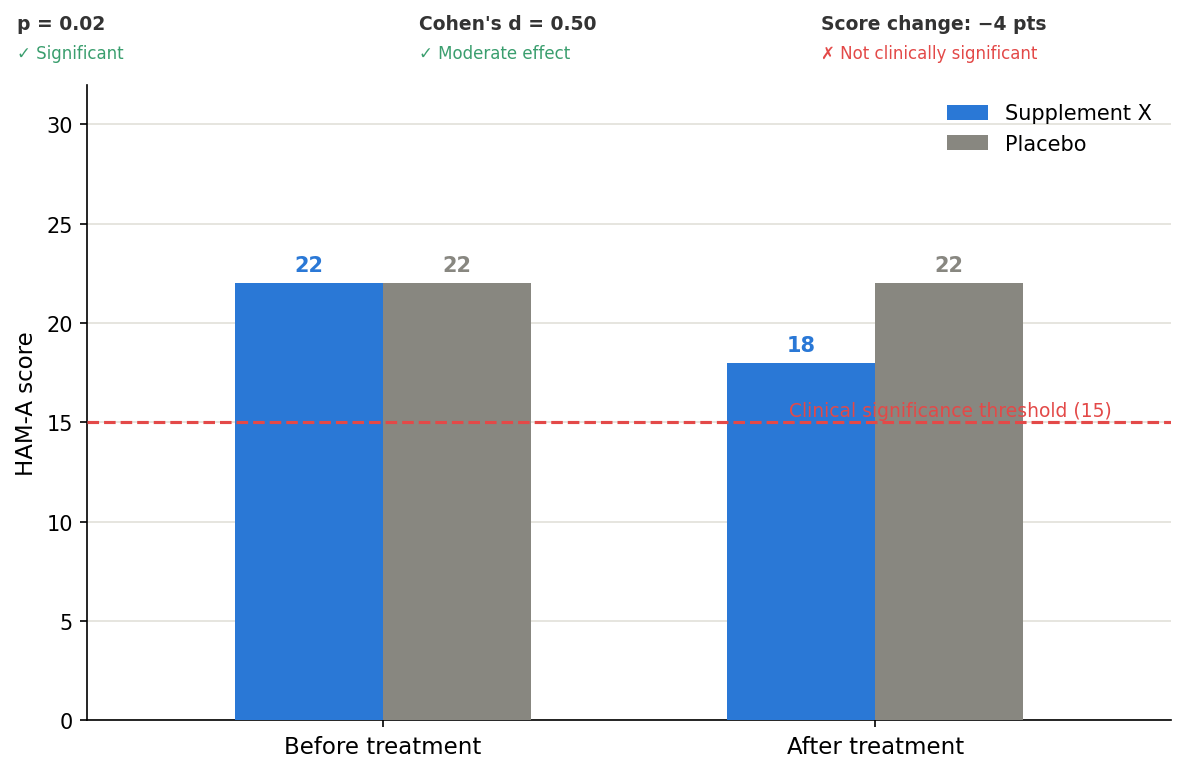
Treatment group: starts at 22, drops to 18 after treatment (4-point reduction)
Placebo group: stays at 22 (0-point reduction)
Cohen’s d = 0.50 (moderate effect size)
p = 0.02 (statistically significant)
Looks promising, right? Here’s the problem: clinical guidelines define a meaningful improvement as a 7-point reduction on the HAM-A - that’s the threshold where patients typically report feeling genuinely better in their daily lives. Therefore, the things you want to look at to evaluate the efficacy of a treatment is 1) significance; 2) effect size; 3) clinical significance.
The chart below shows where the “after treatment” score would need to land to be clinically significant. Supplement X gets close - but not quite there.
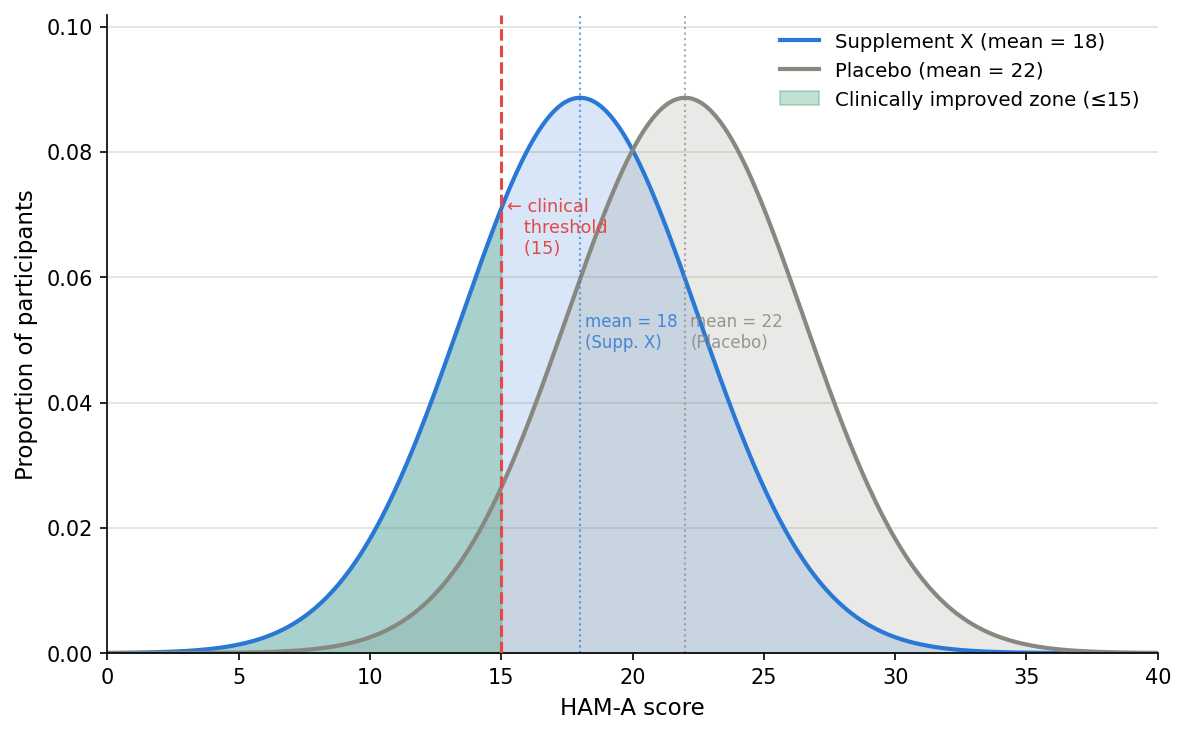
This second chart might be even more intuitive: it shows the distribution of individual scores in both groups. The group averages shifted, but the distributions heavily overlap.
Notice how the two distributions overlap almost entirely. Even though the group means are statistically different, most individuals in the supplement group land in the same anxiety range as the placebo group. And almost nobody in either group crosses into the clinically improved zone below the threshold.
What this means for you
When reading about supplement studies, don’t just look for “statistically significant results.” Ask yourself:
How many points did symptoms actually improve?
Does that meet the clinical significance threshold for that particular test?
How much overlap is there between treatment and placebo groups?
A supplement can be “proven to work” statistically while still leaving most people feeling about the same.
A single RCT, however well-designed, is rarely the whole story. That’s where systematic reviews or meta-analyses come in.
Systematic Review
A systematic review is like a comprehensive investigation of all available research on a specific question. Instead of conducting a new experiment, researchers systematically search for, evaluate, and synthesize all existing studies on a topic - for example, “Does magnesium help with anxiety?”
The systematic process includes:
Comprehensive search: Researchers search available databases using predetermined keywords to find every relevant study, including unpublished ones (to avoid “publication bias” where negative results often don’t get published)
Strict inclusion criteria: Studies are screened using predefined criteria (e.g., only RCTs, only studies lasting at least 4 weeks, only certain doses)
Quality assessment: Each included study is evaluated for methodological quality using standardized tools. Were participants truly randomized? Was blinding maintained? Were dropouts accounted for? Did treatment and placebo groups have the same initial qualities in terms of age, sex, symptoms, and so on when they entered the study?
Evidence synthesis: Researchers summarize what the collective evidence shows, noting where studies agree and disagree
Why systematic reviews are valuable:
Single studies can be misleading due to unintended biases: One positive study might be a statistical fluke or the result of methodological flaws. There are famous historical studies that could never be replicated and, in some cases, we still don’t understand why that is. Looking at all the evidence together gives a more reliable picture.
Identify patterns: Maybe magnesium works better at certain doses, in certain populations, or in specific formulations - patterns that emerge only when looking across studies.
Reveal gaps: Systematic reviews often conclude “more research needed” - but they tell us what kind of research is missing.
Limitations and why findings can be inconclusive:
Poor Quality: If the underlying studies are poorly designed, small, or biased, the systematic review can only work with that limited evidence
Apples and oranges: Studies might use different doses (50 mg vs. 500 mg), different formulations (magnesium oxide vs. glycinate), different populations (healthy adults vs. clinical anxiety disorders), and different outcome measures (HAM-A vs. state-trait anxiety inventory vs. custom questionnaires). This heterogeneity makes it hard to draw unified conclusions.
Publication bias: Despite efforts to find unpublished studies, negative results often remain hidden, potentially making treatments look more effective than they really are
Quality varies: Some systematic reviews are more rigorous than others. Look for phrases like “registered protocol” (pre-specified methods), “risk of bias assessment,” and “GRADE assessment” (rating quality of evidence)
Pre-registered trials: Whether the trial was pre-registered (searchable at ClinicalTrials.gov or the WHO trial registry) - pre-registered studies commit to their methods and outcomes before data collection begins, making it much harder to selectively report only the results that look good
How to read a systematic review conclusion:
Systematic reviews typically rate their confidence in the evidence:
High quality evidence: Further research is very unlikely to change our confidence in the estimate of effect
Moderate quality evidence: Further research is likely to have an important impact
Low quality evidence: Further research is very likely to have an important impact
Very low quality evidence: Any estimate of effect is very uncertain
When you see phrases like “modest evidence,” “inconsistent findings,” or “limited by small sample sizes,” the reviewers are telling you: yes, there’s some signal here, but we can’t tell if there’s really a solid effect present.
Example:
A 2024 systematic review on magnesium for anxiety might include:
7 RCTs with 500 total participants
Studies used doses ranging from 200-500 mg/day
4 studies showed significant improvement, 3 showed no difference from placebo
Quality assessment revealed 3 studies had high risk of bias (small samples, unclear randomization)
Conclusion: “Low quality evidence suggests magnesium may modestly reduce anxiety symptoms, particularly in individuals with low baseline magnesium levels. Significant heterogeneity limits confidence. Higher quality studies with standardized formulations needed.”
This tells you: there’s something there, but the evidence is inconsistent, and the devil is in the details (dose, form, who it’s for, and how it’s conducted).
Meta-Analysis: Combining the Numbers
A systematic review surveys the landscape of existing research and synthesizes it narratively. A meta-analysis goes one step further: it mathematically pools the numerical results from multiple studies into a single statistical estimate. Think of it as taking the results from ten separate experiments and running one large, combined analysis, as if all the participants had been in the same study.
How it works
Each included study contributes a result - say, the mean reduction in anxiety scores in the treatment group versus placebo. The meta-analysis weights these results, typically giving more influence to larger, more precise studies and less to small or imprecise ones. The output is a pooled effect size with its own confidence interval, representing the best single estimate the combined evidence can produce.
Results are usually displayed in a forest plot - a visual summary where each study appears as a horizontal line (its confidence interval) with a square in the middle (its effect estimate). The size of the square reflects the study’s weight in the analysis. At the bottom, a diamond summarizes the pooled result. If the diamond sits clearly to the left of zero (for symptom reduction scales), the overall evidence favors the treatment. If it straddles zero, the evidence is inconclusive.
Why meta-analyses are more powerful - and still fallible
By combining data across studies, a meta-analysis can detect effects too small for any single trial to reliably measure. It also reduces the influence of any one study’s quirks or errors. This is why meta-analyses sit at the top of the traditional evidence hierarchy, above even individual well-designed RCTs.
But meta-analyses are only as good as the studies they include. Researchers sometimes summarize this with the phrase “garbage in, garbage out.” If the underlying trials are small, poorly randomized, or biased toward positive results, the pooled estimate will inherit those problems - and wrap them in a false sense of mathematical precision.
The other major challenge is heterogeneity: when studies differ substantially in dose, population, duration, or outcome measure, pooling their numbers may not be meaningful. A meta-analysis that combines a 6-week trial using 125 mg of ashwagandha root extract with a 12-week trial using 600 mg of a whole-plant extract in a different population is essentially averaging apples and oranges. Well-conducted meta-analyses test for and report heterogeneity using a statistic called I² - values above 50–75% suggest the studies are too different to pool meaningfully, and conclusions should be interpreted with extra caution.
What to look for when you see a meta-analysis cited
How many studies and participants were included? A meta-analysis of 4 small studies is far less convincing than one pooling 20 well-powered trials
Is the I² statistic reported, and if high, do the authors explain it?
Does the forest plot show consistent results across studies, or do some point in opposite directions?
Did the authors test for publication bias - for example, using a funnel plot or Egger’s test? Asymmetric funnel plots suggest that small negative studies may be missing from the literature, inflating the apparent effect
Is the GRADE rating provided? (High / Moderate / Low / Very Low confidence in the pooled estimate)
A note on umbrella reviews
When a topic has accumulated enough meta-analyses, researchers sometimes conduct an umbrella review - a systematic review of meta-analyses. These sit at the very top of the evidence pyramid and give you the most consolidated view of what the science actually shows. In the supplement world, umbrella reviews often deliver a sobering reality check: effects that look robust in individual meta-analyses shrink considerably when the full body of evidence is examined together.
Summary: Your Quick Reference Guide
When evaluating an RCT, ask:
Was it double-blind and placebo-controlled?
How many participants? (Hundreds is better than dozens)
How long did it run? (Weeks vs. months matters)
Was the improvement statistically significant AND clinically significant?
What was the effect size? (Look for Cohen’s d ≥ 0.5 for at least moderate)
When reading a systematic review or meta-analysis, look for:
How many studies were included and their total sample size
The quality rating (high, moderate, low, very low)
Consistency of findings across studies
Whether they note heterogeneity (apples vs. oranges problem)
Phrases like “registered protocol” and “GRADE assessment”
Red flags in any research:
Only one small study supporting a claim
No placebo control group (e.g., ‘waitlist control’ is not the same)
Industry funding without disclosure
Claims of “significance” without reporting actual score changes
Missing information about dropouts or side effects
Final Thoughts
Understanding research doesn’t require a PhD - it just requires knowing which questions to ask. The next time you read that a supplement is “clinically proven,” you now know the three questions that headline isn’t answering: How big was the effect? Did it clear the clinical significance threshold? And what did the systematic review of all the evidence actually say - not just the one study the brand cited? Armed with those questions, you’re already reading more carefully than most.
Most importantly, remember this: “statistically significant” ≠ “life-changing.” A result can be real, measurable, and published in a peer-reviewed journal while still making barely any difference to how you actually feel day-to-day.
The supplement industry thrives on the gap between statistical significance and clinical significance. Now you know how to spot that gap.
Did you find this helpful?
Share it with someone who is always asking “but does it actually work?”
Great post once again!
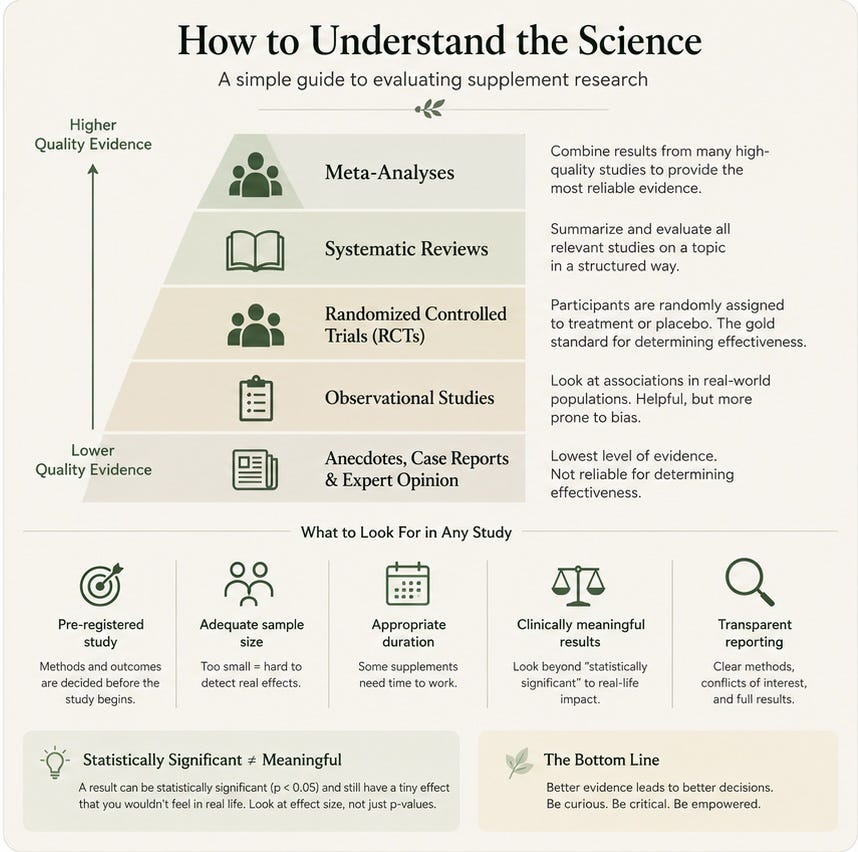
This was insightful! Thank you for writing, and the graphic detailing the different types of studies/qualities within a study again is so good, I love a bite-sized review💕