
What is a Theory?
Understanding the difference between theories, hypotheses, research results, and facts

Before exploring what makes a theory scientific, one crucial foundation: measurement matters. If your measuring technique is flawed, your results won’t contribute to scientific knowledge – they will contradict existing findings and create confusion. A blood pressure study using an uncalibrated device tells us nothing about the drug being tested.

This matters because, as we’ll see, science builds knowledge through replication and accumulation. Bad measurement undermines that entirely.
Also see my previous publications:
· “How to read a scientific paper”
· “How we measure nervous system regulation”
Now, what exactly is a theory?
What is a theory?
In the scientific environment, a theory is a structured framework that explains real-world observations. It fulfills several key criteria:
1. It contains conceptual definitions:
It clearly defines what its terms mean. Examples:
Working memory theory (Baddeley & Hitch, 1974) defines “working memory” as the system that temporarily holds and manipulates information (like remembering a phone number while dialing), distinct from long-term storage.
Attention theory specifies what “selective attention” means -focusing on one conversation at a noisy party while filtering out others (the “cocktail party effect,” described by Cherry, 1953).
2. It specifies its domain:
It describes the conditions under which it applies - and where it doesn’t. Examples:
Dual-process theory (Kahneman, 2011; Stanovich & West, 2000) explains how we make quick, intuitive decisions versus slow, deliberate ones - but doesn’t claim to explain reflexes or unconscious bodily functions.
Sleep consolidation theory (Stickgold & Walker, 2005) applies to how we transfer memories during sleep, but doesn’t explain why we get physically tired.
3. It allows for predictions:
It generates expectations about what should happen. Examples:
If sleep helps consolidate memories (Walker & Stickgold, 2004), then people who study before sleeping should remember more than those who stay awake - testable and confirmed.
If attention is limited (Broadbent’s filter theory, 1958), then trying to text while driving should impair reaction time - and it does.
4. It can be tested:
Its predictions can be examined empirically. Examples:
The “use it or lose it” brain plasticity theory (Merzenich et al., 1980s-90s) predicts that learning new skills creates new neural connections - observable through brain imaging.
Spacing effect theory (Ebbinghaus, 1885; Cepeda et al., 2006) predicts that studying material over several days works better than cramming - testable with student performance data.
5. It is falsifiable:
If contradictory evidence emerges, the theory can in principle be disproven. Examples:
If people who never slept still formed perfect long-term memories, sleep consolidation theory would be disproven.
If brain scans showed no difference between paying attention and being completely distracted, our theories about attention (Posner & Petersen, 1990) would need complete revision.
Falsifiability is crucial. A theory that cannot be proven wrong is not scientific - it becomes belief rather than explanation.
A strong theory survives repeated attempts to disprove it.
Theory vs. Hypothesis
A hypothesis is a testable prediction derived from a theory - or a preliminary explanation that may lead to one.
Key differences:
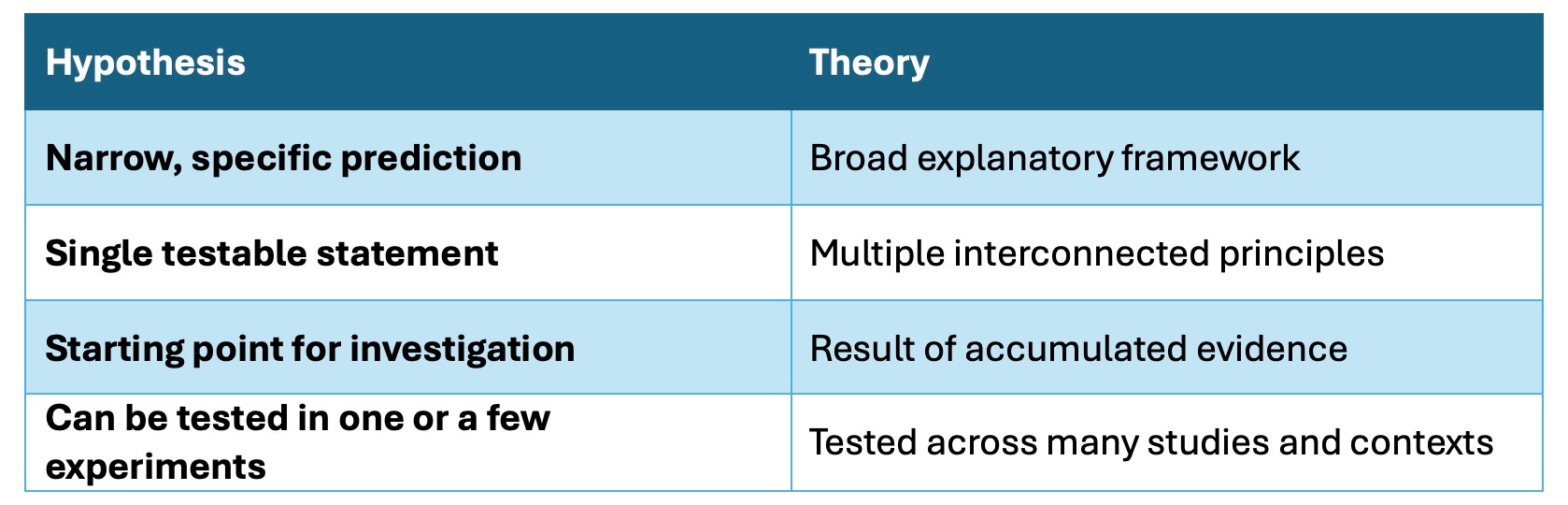
Example:
Hypothesis
“If I drop this ball, it will fall” is a testable hypothesis. It is an “if, then” statement that can be based on a new or existing theory.
Gravitational theory:
· Explains why objects attract
· Predicts behavior across contexts (Earth, Moon, planetary orbits), and
· Unifies diverse observable phenomena under one big umbrella framework
A hypothesis becomes part of a theory when it fits into a larger, coherent framework that explains multiple observations.
What Makes a Good Theory?
A strong theory:
Explains existing data
Makes testable predictions
Can be falsified
Is internally coherent
Adapts when new evidence emerges
Importantly, theories are not static truths. They evolve. Science progresses not by defending theories, but by refining or replacing them when better explanations appear.
Galileo and Heliocentrism: Theory in Action
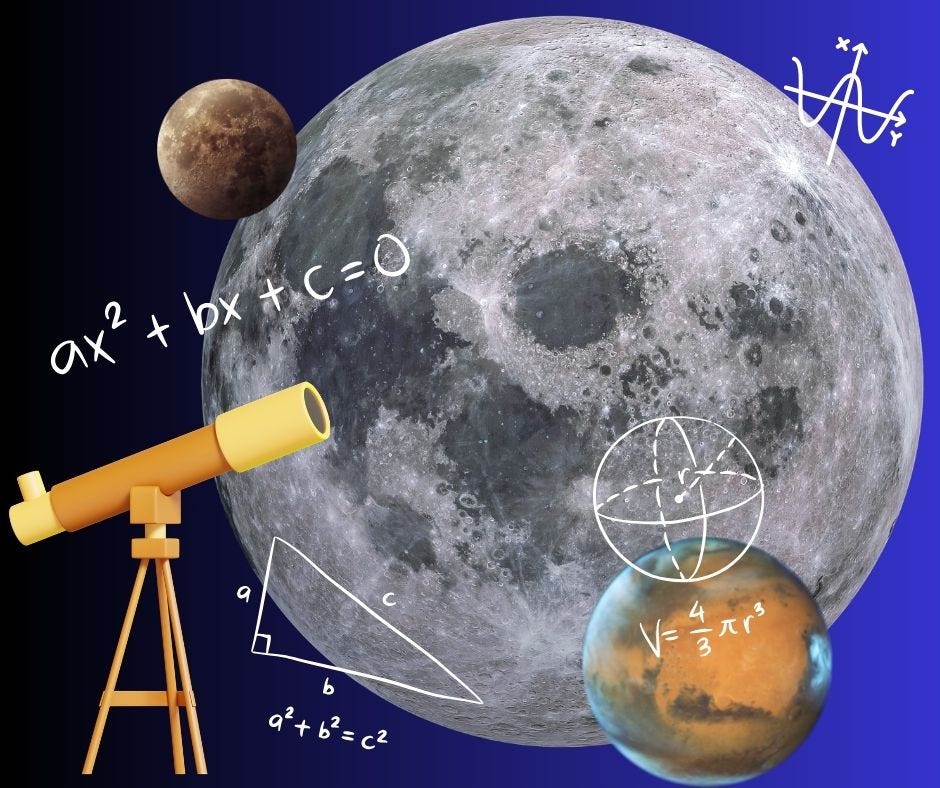
Galileo Galilei was an Italian physicist, mathematician, and astronomer, who lived from 1564-1642. Before his revolutionary observations, the existing geocentric theory stated that the sun and all the planets revolved around the planet Earth. This theory was strongly defended, since at the time, it was believed that God placed humans on the Earth as the center of His creations. Galileo improved existing telescope design and was able to not only observe novel details about the planets and their behaviors in space, but was also provided strong evidence through systematic observation and mathematics that in fact the Earth (and other planets) revolved around the sun (known as Copernicus’s heliocentric theory).
The church was not amused. In 1633, he was tried by the Inquisition, forced to recant, and spent his final years under house arrest. However, at the end of the day, Galileo demonstrated that observation and evidence should trump authority and tradition - a foundational principle of modern science. The debate over Earth’s orbit demonstrates how theories compete, evolve, and get replaced. This is called a scientific revolution and we need to remind ourselves, that when we get faced with a new theory, exploring with an open mind might lead to the truth, while stubbornly sticking to what we want to believe can lead to ignorance.
Research Results vs. Facts
Research results are findings from specific studies under particular conditions.
Facts are well-established observations confirmed repeatedly across contexts.
A Clear Example: Caffeine and Memory
Research Result:
A single study tests whether caffeine improves memory in 60 college students (ages 18-22) at one university. Results show 15% improvement compared to placebo-control.
What we can actually conclude:
· In this specific sample, caffeine improved performance compared to placebo
· We don’t know if this applies to older adults, regular coffee drinkers, different times of day, or different memory tasks
Why one study isn’t enough:
· Results could be chance
· Sample might be unusual in some regard
· Methodology might have hidden flaws
· Context-specific factors might explain the effect
Becoming a Fact:
After hundreds of studies across different ages, populations, doses, and methods, we can establish facts:
· Caffeine is a stimulant affecting the central nervous system
· Caffeine blocks adenosine receptors in the brain
· Moderate caffeine intake temporarily increases alertness in most people
These are facts because they’ve been repeatedly confirmed across varied conditions.
Critical Distinction
Research results:
· May not replicate (e.g., might work once and never again)
· Depend on methodology, sample, context
· Require interpretation
· Can be contradictory across studies
Facts:
· Are reproducible under specified conditions
· Form the observational foundation theories must explain
· Can still be contextual (water boils at different temperatures at different pressures)

Common Misunderstandings
“It’s just a theory”
In everyday language, “theory” is often used as a guess or hunch. In science, a theory is the highest form of understanding; a comprehensive explanation that can predict future events, supported by substantial evidence.
Evolution, gravity, working memory theory are all “theories” that are as well-established as scientific knowledge gets.
“Theories become facts when proven”
No. Theories explain facts. Facts are observations; theories are explanations.
Fact: Objects fall toward Earth when dropped
Theory: General relativity explains this as spacetime curvature caused by mass
“A single contradictory result disproves a theory”
Not necessarily. The result may be:
Measurement error
Artifact of methodology
Indication the theory needs refinement, not replacement
Valid evidence requiring theory modification
Strong theories withstand isolated contradictions. They’re replaced when a better explanatory framework emerges - one that explains both old observations and new contradictions. It is also important to note that scientists are human beings. If a scientist establishes a new theory, dedicates their life to gathering evidence for the theory, this scientist will become somewhat biased and more reluctant to give up the theory for some minor pieces of novel counterevidence.
Recent example
In 2024, 38 scientists published critiques of Stephen Porges’ Polyvagal Theory. This is science working as intended - challenging established frameworks. But it also illustrates human nature: scientists who dedicate careers to a theory become invested in it. Disproving well-established theories requires extraordinary evidence, not just contradictory data points. This tension between openness to revision and resistance to premature abandonment drives scientific progress. We may never know everything, but that keeps it exciting.
Summary
Understanding the distinction between theory, hypothesis, research results, and facts prevents:
Misinterpreting preliminary findings as established knowledge
Dismissing well-supported theories as “mere speculation”
Confusing explanation with observation
Demanding absolute certainty where science offers probabilistic confidence
Science does NOT offer absolute truth. It offers the best current explanations based on available evidence - explanations that improve as evidence accumulates.
Galileo didn’t ‘prove’ the Earth orbits the Sun. He provided observations that the spherical-Earth-in-heliocentric-system theory explained better than alternatives. The theory won because it worked better, not because it was “proven true.”
That’s how science progresses: better explanations replacing worse ones, always remaining open to revision when evidence demands it.

Final Questions
When you see a headline claiming “Study shows X causes Y,” what questions should you ask before accepting it?
If tomorrow’s evidence could overturn today’s best theory, does that make current scientific knowledge unreliable - or is revision exactly what makes it reliable?
What beliefs do you hold that are unfalsifiable? Does that make them unscientific, or do some important truths exist outside science’s domain?
If you found this article valuable:
✓ Share it with someone who needs clearer thinking about science
✓ Subscribe for weekly breakdowns of neuroscience concepts
✓ Leave a comment with your questions—I respond to every one
I write to make research accessible without dumbing it down. You shouldn’t need a PhD to understand how science actually works.
Warm greetings,
Bea
Thank you for this informative article 🙂